
NOAA Logo

NWS Logo

Organizations

Space Weather Prediction Center

National Oceanic and Atmospheric Administration

Thursday, January 15, 2026 20:16:24

Main menu

NOAA Scales mini

minimize icon
Space Weather Conditions
24-Hour Observed Maximums
R
no data
S
no data
G
no data
Latest Observed
R
no data
S
no data
G
no data
R1-R2 --
R3-R5 --
S1 or greater --
G
no data
R1-R2 --
R3-R5 --
S1 or greater --
G
no data
R1-R2 --
R3-R5 --
S1 or greater --
G
no data
maximize icon
R
no data
S
no data
G
no data
Current Space Weather Conditions
R1 (Minor) Radio Blackout Impacts
close
HF Radio: Weak or minor degradation of HF radio communication on sunlit side, occasional loss of radio contact.
Navigation: Low-frequency navigation signals degraded for brief intervals.
More about the NOAA Space Weather Scales

Who’s That Photobombing the Sun?

Who’s That Photobombing the Sun?
published: Thursday, January 15, 2026 20:11 UTC

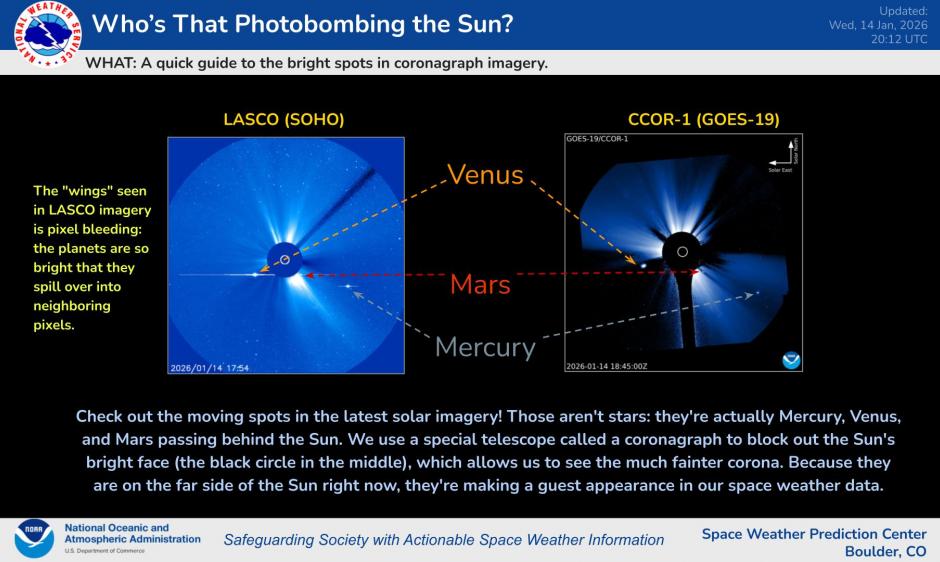
While they might look like stars, the bright spots in the latest coronagraph imagery are actually the planets Mercury, Venus, and Mars passing behind the Sun from Earth’s perspective. To see them, we use a specialized telescope called a coronagraph, which utilizes an internal occulting disk to block out the Sun’s direct glare. This allows us to observe the much fainter solar corona.

DAP - temp Head Section