



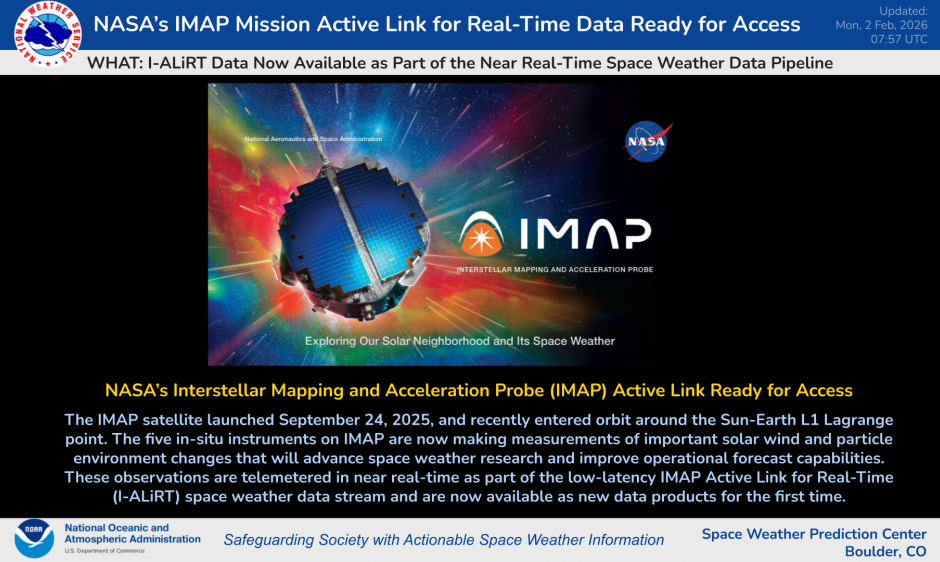
After launching on September 24, 2025, NASA’s Interstellar Mapping and Acceleration Probe (IMAP) observatory recently entered orbit around the Sun-Earth L1 Lagrange point. In addition to new heliophysics science observations, five in-situ instruments on IMAP make measurements that are critical for advancing space weather research and operational forecasting. These measurements are continuously telemetered in near real-time as part of the low-latency IMAP Active Link for Real-Time (I-ALiRT) space weather data stream. The I-ALiRT data set includes ACE-heritage products at higher measurement cadences and also new data products that are available for the first time as part of the near real-time space weather data pipeline. These new products include high-energy electron count rates, helium ion count rates, solar wind charge state ratios and elemental abundances, and counterstreaming electron flow information. NOAA/Space Weather Prediction Center forecasters look forward to having access to the I-ALiRT data sets from IMAP to improve timeliness of energetic particle event warnings, alerts, and forecasts.
For more information about I-ALiRT, including access to the quick look plots and data files, please visit https://imap-mission.com/ialirt. For further information about the IMAP mission, see McComas et al. 2025 - Open Access: https://link.springer.com/article/10.1007/s11214-025-01224-z.