

NOAA Logo

NWS Logo

Organizations

Space Weather Prediction Center

National Oceanic and Atmospheric Administration

Monday, January 19, 2026 21:37:54

Main menu

NOAA Scales mini

minimize icon
Space Weather Conditions
24-Hour Observed Maximums
R
no data
S
no data
G
no data
Latest Observed
R
no data
S
no data
G
no data
R1-R2 --
R3-R5 --
S1 or greater --
G
no data
R1-R2 --
R3-R5 --
S1 or greater --
G
no data
R1-R2 --
R3-R5 --
S1 or greater --
G
no data
maximize icon
R
no data
S
no data
G
no data
Current Space Weather Conditions
R1 (Minor) Radio Blackout Impacts
close
HF Radio: Weak or minor degradation of HF radio communication on sunlit side, occasional loss of radio contact.
Navigation: Low-frequency navigation signals degraded for brief intervals.
More about the NOAA Space Weather Scales

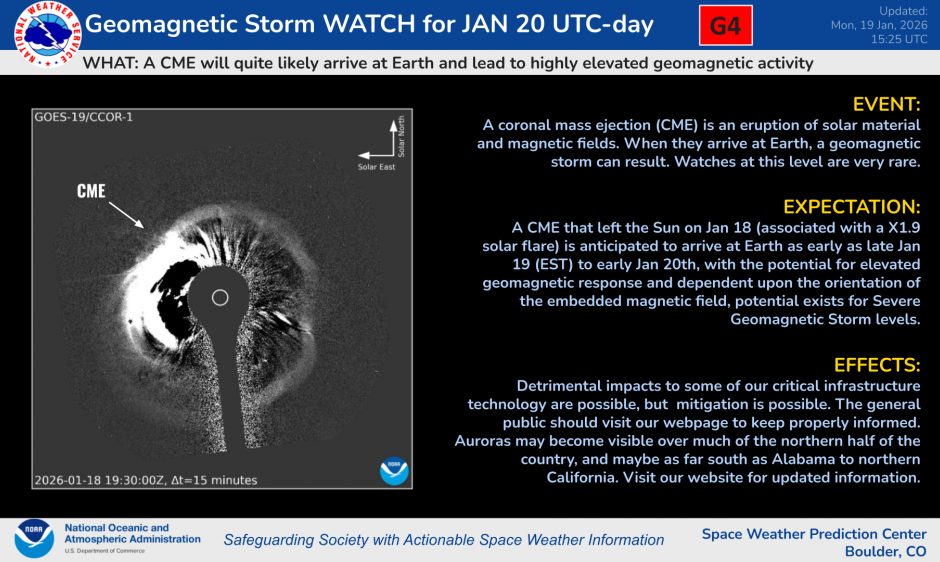
G4 (Severe) Geomagnetic Storm Watch for 20 January UTC-Day

G4 Watch for 20 Jan
G4 (Severe) Geomagnetic Storm Watch for 20 January UTC-Day
published: Monday, January 19, 2026 15:37 UTC

A G4 (Severe) geomagnetic storm watch is in effect for the 20 January UTC-day due to Earth-arrival of a coronal mass ejection (CME). The CME blasted from the Sun on 18 Jan, in association with an energetic R3 (Strong) solar flare from a sunspot region near center-disk, and is anticipated to arrive at Earth as early as late 19 Jan EST to early 20 Jan. While the G4 Watch is out for the 20 Jan UTC-day, geomagnetic storm levels could range from G1-G3 (Minor-Moderate) upon CME arrival later on 19 Jan EST. CME passage is expected to continue through 20 Jan, but conditions are likely to weaken later in the day. G1 levels remain possible on 21 Jan due to residual CME related effects. Forecasters have a fair measure of confidence in timing and of CME arrival at Earth. Please continue to visit our SWPC webpage for the latest forecasts, information, and updates.

DAP - temp Head Section