



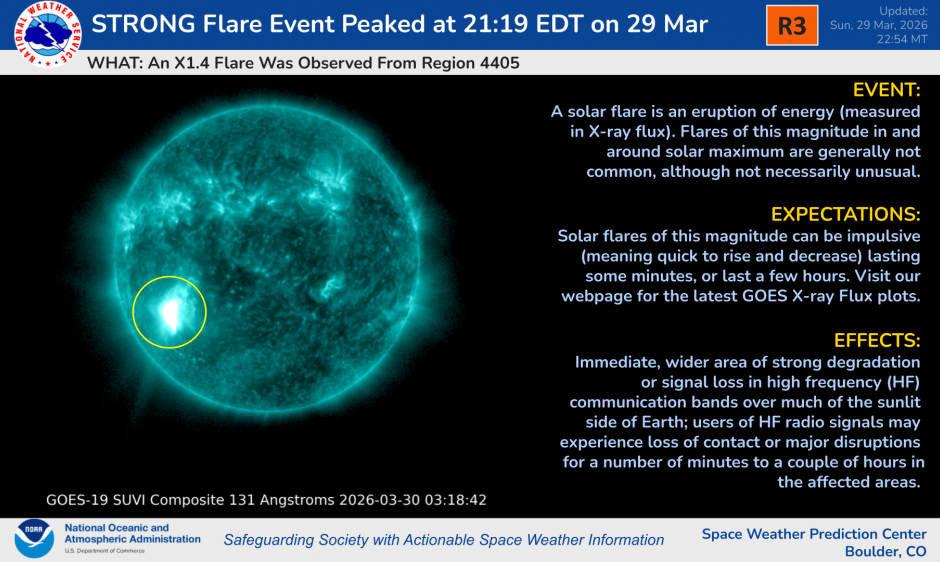
Solar Activity Update: X1.4 Flare and Associated CME
Solar activity reached high levels on 30 March 2026 with the observation of an X1.4 flare from Region 4405 (S27E44, Eao/beta-gamma). The event peaked at 0319 UTC and resulted in an R3 (Strong) Radio Blackout on the sunlit side of Earth. D-RAP modeling indicated wide-area degradation of high frequency (HF) communication centered over the Maritime Continent, including Southeast Asia and Northern Australia. Region 4405 remains magnetically complex, and forecasters are continuing to monitor it for further eruptions.
The flare was associated with a Type II radio sweep with an estimated velocity of 1872 km/s and a 10 cm radio burst with a peak flux of 1800 sfu.
An associated Coronal Mass Ejection (CME) is visible in coronagraph imagery. The event is first visible in SOHO/LASCO C2 imagery at 0312 UTC, in STEREO-A COR2 at 0323 UTC, and in GOES-19 CCOR-1 at 0345 UTC. Analysis for possible Earth impacts is ongoing.