

NOAA Logo

NWS Logo

Organizations

Space Weather Prediction Center

National Oceanic and Atmospheric Administration

Monday, March 16, 2026 14:21:32

Main menu

NOAA Scales mini

minimize icon
Space Weather Conditions
24-Hour Observed Maximums
R
no data
S
no data
G
no data
Latest Observed
R
no data
S
no data
G
no data
R1-R2 --
R3-R5 --
S1 or greater --
G
no data
R1-R2 --
R3-R5 --
S1 or greater --
G
no data
R1-R2 --
R3-R5 --
S1 or greater --
G
no data
maximize icon
R
no data
S
no data
G
no data
Current Space Weather Conditions
R1 (Minor) Radio Blackout Impacts
close
HF Radio: Weak or minor degradation of HF radio communication on sunlit side, occasional loss of radio contact.
Navigation: Low-frequency navigation signals degraded for brief intervals.
More about the NOAA Space Weather Scales

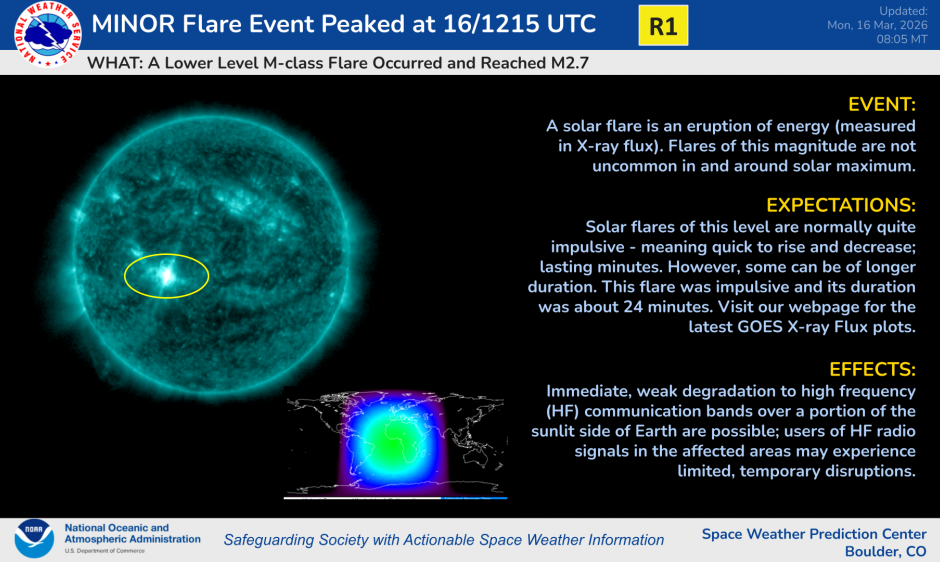
R1 Event Early on 16 March 2026

R1 Event Early on 16 March 2026
published: Monday, March 16, 2026 14:07 UTC

NOAA/SWPC Region 4392 erupted with an M2.7 (R1-Minor) solar flare early on 16 March, 2026. The flare began at 0800 EDT (1200 UTC) and lasted 24 minutes, which could have caused some minor high frequency (HF) radio communications’ degradation over the Atlantic Ocean, Africa, and southern Europe; particularly at the higher end of the HF radio spectrum. Analyses of the solar flare in various GOES-19 SUVI imagery indicated characteristics associated with a coronal mass ejection (CME). Additionally, radio signatures known as radio sweeps were observed by the USAF/SPACEAF radio solar telescope network (RSTN) that also indicated possible CME movement, however, we are currently waiting for coronagraph imagery to be available in order to determine if a CME indeed erupted from the Sun and if so, to analyze and model it to determine and potential Earth-directed component. Continue to visit or webpage for the latest updates and information.

DAP - temp Head Section