
NOAA Logo

NWS Logo

Organizations

Space Weather Prediction Center

National Oceanic and Atmospheric Administration

Tuesday, March 31, 2026 18:53:43

Main menu

NOAA Scales mini

minimize icon
Space Weather Conditions
24-Hour Observed Maximums
R
no data
S
no data
G
no data
Latest Observed
R
no data
S
no data
G
no data
R1-R2 --
R3-R5 --
S1 or greater --
G
no data
R1-R2 --
R3-R5 --
S1 or greater --
G
no data
R1-R2 --
R3-R5 --
S1 or greater --
G
no data
maximize icon
R
no data
S
no data
G
no data
Current Space Weather Conditions
R1 (Minor) Radio Blackout Impacts
close
HF Radio: Weak or minor degradation of HF radio communication on sunlit side, occasional loss of radio contact.
Navigation: Low-frequency navigation signals degraded for brief intervals.
More about the NOAA Space Weather Scales

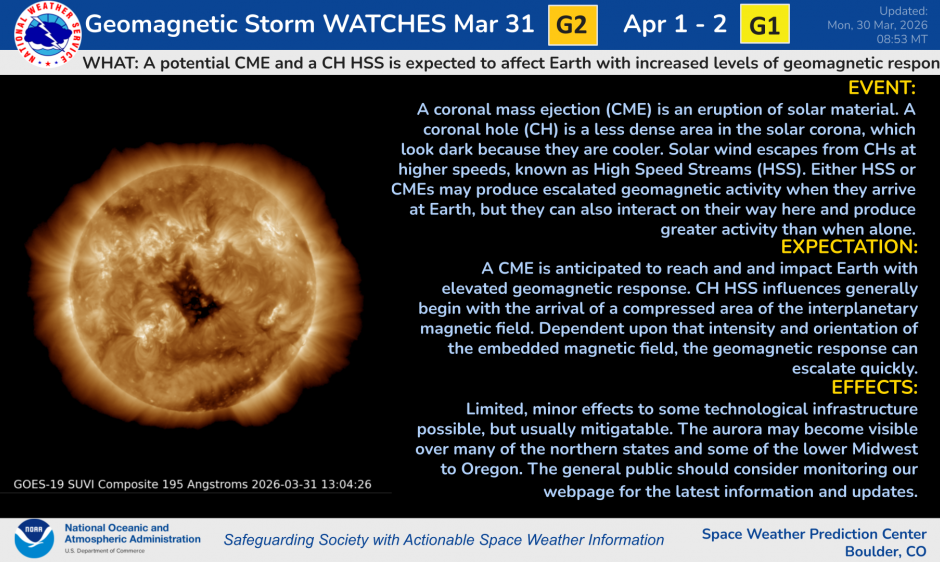
G2-G1 Watches for Mar 31-Apr 02 UTC-Day

A G2 Watch is in effect for March 31 due to the anticipated arrival of a CME, and a G1 Watch is in effect for April 1st and 2nd due to the anticipated arrival of a coronal hole high speed stream.
G2-G1 Watches for Mar 31-Apr 02 UTC-Day
published: Tuesday, March 31, 2026 13:57 UTC

A fairly fast coronal mass ejection (CME) erupted from the Sun late on March 29th (Eastern Time). The CME was associated with an X1.4 solar flare (R3-Strong) from Region 4405 in the southeast quadrant of the Sun. Due to the proximity of a coronal hole to this Region, the CME is expected to interact with the area of compressed solar wind ahead of an anticipated high speed stream, with a potential arrival at Earth on March 31st. A G2 (Moderate) Watch is in effect for the March 31st UTC-day, with a G1 (Minor) Watch in effect for April 1st and 2nd. Stay informed from the Nation’s official source of space weather forecasts and information.

DAP - temp Head Section