

NOAA Logo

NWS Logo

Organizations

Space Weather Prediction Center

National Oceanic and Atmospheric Administration

Thursday, April 02, 2026 20:07:12

Main menu

NOAA Scales mini

minimize icon
Space Weather Conditions
24-Hour Observed Maximums
R
no data
S
no data
G
no data
Latest Observed
R
no data
S
no data
G
no data
R1-R2 --
R3-R5 --
S1 or greater --
G
no data
R1-R2 --
R3-R5 --
S1 or greater --
G
no data
R1-R2 --
R3-R5 --
S1 or greater --
G
no data
maximize icon
R
no data
S
no data
G
no data
Current Space Weather Conditions
R1 (Minor) Radio Blackout Impacts
close
HF Radio: Weak or minor degradation of HF radio communication on sunlit side, occasional loss of radio contact.
Navigation: Low-frequency navigation signals degraded for brief intervals.
More about the NOAA Space Weather Scales

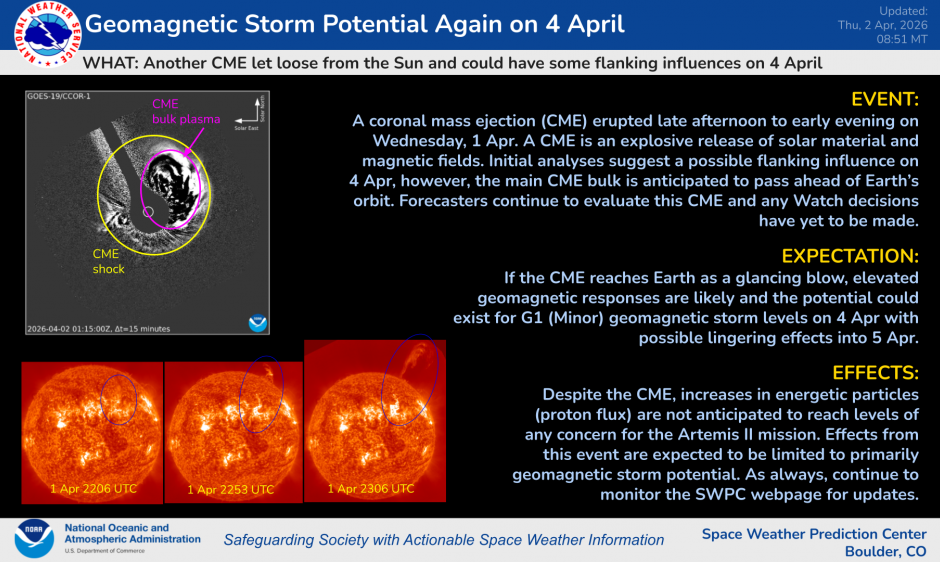
CME Blasted from the Sun on 1 April - Possible Influences on 4 April

CME Blasted from the Sun on 2 April - Possible Influences on 4 April
CME Blasted from the Sun on 1 April - Possible Influences on 4 April
published: Thursday, April 02, 2026 15:09 UTC

A coronal mass ejection (CME) as part of a filament eruption occurred on 1 April. Initial analyses of the CME suggests primarily an arrival just ahead and mostly north of Earth’s orbit. However, some outlier model runs hint at some glancing influences by 4 April. SWPC forecasters continue to evaluate this CME and will make and possible geomagnetic storm Watch decisions as the forecast becomes finalized.

DAP - temp Head Section