
NOAA Logo

NWS Logo

Organizations

Space Weather Prediction Center

National Oceanic and Atmospheric Administration

Thursday, January 29, 2026 13:54:19

Main menu

NOAA Scales mini

minimize icon
Space Weather Conditions
24-Hour Observed Maximums
R
no data
S
no data
G
no data
Latest Observed
R
no data
S
no data
G
no data
R1-R2 --
R3-R5 --
S1 or greater --
G
no data
R1-R2 --
R3-R5 --
S1 or greater --
G
no data
R1-R2 --
R3-R5 --
S1 or greater --
G
no data
maximize icon
R
no data
S
no data
G
no data
Current Space Weather Conditions
R1 (Minor) Radio Blackout Impacts
close
HF Radio: Weak or minor degradation of HF radio communication on sunlit side, occasional loss of radio contact.
Navigation: Low-frequency navigation signals degraded for brief intervals.
More about the NOAA Space Weather Scales

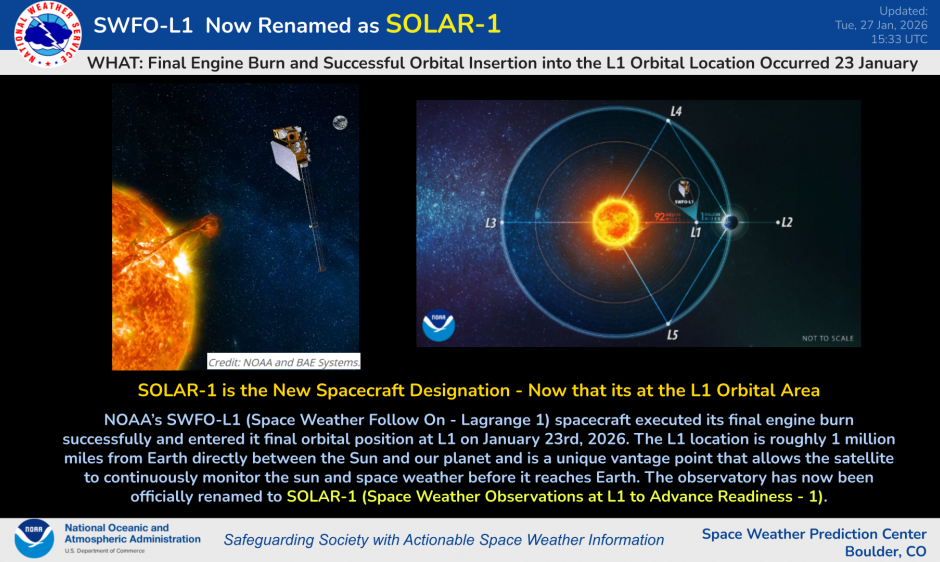
SOLAR-1 Is Now The New Designation for SWFO-L1

SOLAR-1 is new name for SWFO-L1
SOLAR-1 Is Now The New Designation for SWFO-L1
published: Tuesday, January 27, 2026 16:32 UTC

On January 23, 2026, NOAA’s Space Weather Follow On – Lagrange 1 (SWFO-L1) observatory executed its final engine burn, successfully entering its final orbital position at Lagrange point 1. Located roughly one million miles from Earth, this unique vantage point allows the satellite to continuously monitor the sun and space weather before it reaches our planet. The observatory has now been officially renamed to Space weather Observations at L1 to Advance Readiness – 1 (SOLAR-1). The satellite is expected to be operational during the upcoming spring of 2026. The full story can be found here.

DAP - temp Head Section